Beer pong in one sentence: Two teams face off across an 8-foot table with ten cups racked in a triangle at each end, take turns throwing a ping pong ball into the other side’s cups, remove and drink every cup that is hit, and the first team to clear all ten wins — after the other team gets one last rebuttal.
What Is Beer Pong?
Beer pong is a throwing game for two teams, usually two players a side, played across a long table with ten plastic cups racked in a triangle at each end. Players take turns lobbing a ping pong ball at the opposite rack; every cup a ball lands in is removed from the table and drunk by the team it belonged to. The first team to clear all ten of the opponent’s cups wins, with one rebuttal round to keep it honest.
There is no board, no scorekeeping and no referee — which is exactly why the rules argument is part of the game. The core loop is fixed everywhere, but bounce shots, re-racks, blowing the ball out and the fate of a cup that takes both balls are all decided table by table. The throw-only game most people play today is also called Beirut in parts of the US Northeast, and Wikipedia traces the name back to a paddle version played at Dartmouth in the 1950s — more in the history section below.
It is normally played as a drinking game, and just as easily played with water, soda or points instead — see beer pong without beer.
Beer Pong Equipment: What You Need and What to Buy
The whole kit fits in a grocery bag. Nothing here needs to be branded “beer pong” to work.
- 22 plastic cups. Twenty for the two racks, plus one cup of clean water at each end for rinsing the balls between throws. Standard 16 oz party cups are the norm because their 3¾-inch rims pack into a tight triangle; 18 oz cups work too.
- Two ping pong balls. Regulation 40 mm table tennis balls. Buy a tube of a dozen — balls crack, roll under the sofa and get stepped on. Coloured balls are easier to find on a dark floor.
- A long table. Regulation is 8 feet, but a dining table, a folding banquet table or two desks pushed together all work. See table size for the exact dimensions and what to look for in a purpose-made table.
- Beer, or a substitute. Roughly two beers per side fills a ten-cup rack at the usual pour. Water, soda or juice works exactly the same.
- A towel. Not a rule. You will still want one.
If you want a proper beer pong set
The sets sold online are convenience, not necessity. A folding beer pong table is an 8 ft × 2 ft aluminium top that collapses into a briefcase-sized case, usually with a printed rack outline at each end and a ball-holder rail; a plain 8-foot banquet table from a hardware store is the same size for less money, just heavier. Cup-holder inserts (a rigid triangle with ten holes) stop cups sliding and save re-rack arguments, LED cups are for night games, and an inflatable floating table turns the same rules into a pool game. If you buy one thing, buy the cup-holder insert.
Beer Pong Table Size, Height and Throwing Distance
The regulation table used by the World Series of Beer Pong is 8 feet long, 2 feet wide and 27.5 inches high (244 × 61 × 70 cm). Because each rack takes up just over a foot at its end, the two point cups end up about 6 feet apart, and a player throwing from behind the table edge is roughly 7 feet from the nearest cup and 8 feet from the back row.

| Table | Size | Verdict |
|---|---|---|
| Regulation (WSOBP) | 8 ft × 2 ft × 27.5 in | The reference. Folding beer pong tables copy these numbers. |
| 8 ft banquet table | 8 ft × 30 in × 29 in | Same length, a little wider and higher. Ideal for a house game. |
| 6 ft folding table | 6 ft × 30 in × 29 in | Fine for beginners or a six-cup game; shots are noticeably easier. |
| Dining table | Usually 6–7 ft | Works. Cover it — beer and wood finishes do not mix. |
| Two card tables end to end | About 7 ft | Works if the tops sit level; tape the seam so bounce shots stay honest. |
Whatever you play on, the rule that matters is symmetry: both racks the same distance from their shooters, back rows level with the table ends, so neither side gets a shorter throw.
Beer Pong Setup, Step by Step
Set the two racks up first, then fill them, then decide who throws first.
1. Rack the cups
Put ten cups at each end of the table in a 4–3–2–1 triangle: a row of four along the back edge, then three, then two, then a single cup pointing at the shooter. Every cup should touch its neighbours, and the back row should sit level with the end of the table.
2. Fill the cups
Pour 2–4 oz into each cup — about a third full. Two beers split across a ten-cup rack lands in the right range. Tournaments fill the cups with water and have each player drink from a separate beer instead, which keeps the game hygienic and the pace controlled; that is a good default for a house game too.
3. Set the rinse cup
Put a cup of clean water at each end, off to the side. Balls land on the floor constantly, and rinsing between throws is the difference between a fun night and a bad morning.
4. Decide who shoots first
The traditional method is the eye-to-eye shootout: one player from each team shoots at the same time while holding eye contact with their opponent. If one makes it and the other misses, that team starts. If both make it or both miss, shoot again. A coin toss works just as well.
How to Play Beer Pong: A Turn, Step by Step
- Each player throws one ball. On a team’s turn, both teammates shoot once, in either order. In a 1v1 game, the single player throws both balls.
- A ball that lands in a cup takes that cup. Pull the cup off the table, drink it, and set the empty aside — not back into the rack.
- Both partners make it? Balls back. The balls are returned and the same team shoots again. Runs of made shots keep the turn alive.
- Otherwise, hand the balls over. Roll or pass them across the table rather than throwing them back.
- Repeat until one rack is empty, then go to the rebuttal (below).
Two rules hold the throwing side honest. The elbow rule: your elbow must stay behind the end of the table when you release, and a shot thrown past it does not count even if it goes in. The over-the-table rule: leaning across the table is fine as long as that elbow line is respected.
Two more hold the defending side honest. Cups may not be touched or moved to dodge a ball, and once a ball has touched a cup it is live — catching or swatting it at that point is a grab, and the shooting team is normally awarded the cup. A ball still bouncing around the table before it touches a cup is fair game to swat, though, which is what makes bounce shots risky.
The three beer pong shots
- Arc shot (lob). The default. A high, soft throw that drops into the cup from above and uses the whole mouth of the cup as the target.
- Fastball (line drive). A flat, hard throw aimed at the back rim. It is harder to swat and skips off the rim into a neighbouring cup more often than you would think, but a miss is a miss by a long way.
- Bounce shot. Bounced off the table on the way in. Most house rules make it worth two cups to compensate for the fact that defenders may swat a bouncing ball.
Beer Pong Re-Racks: Shapes and Names
As cups disappear, the leftovers spread out and become harder to hit. A re-rack (also called a reformation or a consolidation) pushes them back into a tight shape.
- Each team gets two re-racks per game in the usual house rule; tournaments often allow one at a specific cup count.
- Call it at the start of your own turn, before either ball is thrown — never mid-turn.
- The cups must all touch, and stay in the same area of the table.
- You ask for the shape; the defending team arranges it.
| Cups left | Shape and name | Why |
|---|---|---|
| 6 | Triangle (3–2–1), a.k.a. the pyramid | Rebuilds the original rack in miniature. |
| 4 | Diamond | Keeps a centre target with margin on all sides. |
| 4 | Square (2×2) | Slightly wider, better for bounce shots. |
| 4 | Zipper (a staggered line) | Long and thin — good for flat throwers, bad for lobbers. |
| 3 | Triangle, a.k.a. the play button | The default three-cup shape for arc shots. |
| 3 | Stoplight (a straight line of three) | Front to back, for players who throw flat. |
| 2 | Gentleman’s (side by side, touching) | Turns two separate targets into one wide one. Many tables give it free without spending a re-rack. |
| 1 | Last cup, moved to the centre or a back corner | Last-cup placement is a house rule — agree on it early. |
Beer Pong House Rules Worth Agreeing On
These are the rules that start arguments. None of them is universal, and all of them change the game a lot. Pick your set before the first throw.
| Rule | What it means | Common ruling |
|---|---|---|
| Bounce shot | Bounce the ball off the table into a cup. | Worth two cups (the one hit plus one of your choice), but defenders may swat a bouncing ball. |
| Death cup | A ball lands in a cup that has been made but not yet drunk. | Instant loss for the team that left it sitting there. Drink your cups promptly. |
| Same cup, both balls | Both teammates sink the same cup in one turn. | Officially just two cups made. House rule: three cups, or an instant win. |
| Heating up / on fire | One player makes several shots in a row. | Two in a row is “heating up”, three is “on fire” — keep shooting until you miss. |
| Island | Call out a cup that touches no other cup before you throw. | Make it and you take two cups; hit any other cup and it does not count. |
| Blowing / fingering | Remove a ball still spinning inside a cup. | Allowed only while the ball is spinning above the liquid. Banned in tournaments. |
| Behind the back | A ball knocked back to your own side of the table. | Shoot it behind your back for a bonus cup if it goes in. |
| Distraction | Waving, noise or movement while an opponent throws. | Allowed as long as no hand crosses the plane of the table. |
| Naked lap | A team loses without making a single cup. | The forfeit is whatever the table decided in advance. Decide something kinder. |
Before you start: this is a drinking game for people over the legal drinking age. Keep the pours small, keep water on the table, eat something, and let anyone swap a cup for water without explaining why — the NIAAA sets out what counts as binge drinking and why it is worth avoiding. Never play a rule that forces someone to keep up, and never drive afterwards.
Winning Beer Pong: Redemption, Rebuttal and Overtime
Sinking the last cup does not end the game on its own. The team that just lost their final cup gets a rebuttal — also called redemption:
- Every player on the losing team shoots, one ball at a time, in any order.
- They keep shooting as long as they keep making cups.
- The first miss ends the game and the other team wins.
- If they clear every remaining cup, the game is tied and goes to overtime.
Overtime uses a three-cup triangle per side, fresh balls and the same rules. The team that did not shoot the rebuttal throws first. Each subsequent overtime keeps the same three-cup rack.
Beer Pong for 2, 3, 4 or More Players
The standard game is 2v2, but the rack does not care how many people are standing behind it.
- 2 players (1v1). Each player throws both balls every turn. Make both and you shoot again. Re-racks and redemption work exactly the same; games are quicker because there is no waiting on a partner.
- 3 players. Two options. Two against one: the solo player throws both balls each turn so both sides get two shots; give the solo player a six-cup rack if the skill gap is wide. Winner stays: play 1v1 with six cups and the loser hands the table to the third player.
- 4 players (2v2). The classic format. Partners alternate who throws first each turn.
- 6 players (3v3). Three balls per turn, one per player, and the “all three make it” rule replaces balls-back. Or drop turns entirely and play Civil War.
- 8 or more. Run a bracket: single elimination, teams of two, winner stays on and the loser fetches the next cups. Six-cup racks keep a queue moving.
Beer Pong Variations
Six-cup (short game)
Six cups in a 3–2–1 triangle, one re-rack each. Half the length, same rules — the right format when you have a queue of people waiting for the table.
Civil War
Three or more players per side, six cups each, and no turns at all. Everyone shoots continuously, retrieving their own ball. Chaotic, fast, and the best version for a large group.
Baseball
Four cups per side in a diamond. Each made cup is a hit, three misses is an out, three outs ends the inning. Play nine innings and count runs like a real box score.
Battleshots
Cups hidden behind a barrier in a grid, and players call coordinates instead of aiming. It is Battleship with cups — a good pick when the throwing skill gap at the table is wide.
Slam cup
Bounce your own ball and slam it into a cup before it stops bouncing. No turns, no teams — whoever grabs a loose ball can shoot.
Beer pong golf
A backyard version: nine or eighteen “holes” are cups spread around the lawn or a patio, and each player counts the throws it takes to sink each one. Lowest total wins, and the drinking is optional.
If your group prefers card games to throwing games, the same energy is in Kings Cup variations and the short, remote and two-player formats there.
Beer Pong Strategy: How to Actually Get Better
- Throw an arc, not a line. A ball dropping in steeply uses the whole cup mouth. A flat throw only has the rim to work with.
- Aim for the back rim of the back-centre cup. Short of it, you still catch a front cup; long, and the ball is gone anyway.
- Fix your stance. Same foot forward, same elbow height, same release point every time. Repeatability beats power.
- Hold the ball on your fingertips, not in your palm, and let the wrist do the work.
- Watch the re-rack count. Save one for the two-cup stage, where a re-rack roughly doubles your target.
- Bounce when they are not looking. A bounce shot is only worth two cups if nobody swats it; take it while the defenders are drinking or arguing.
- Drink your made cups immediately. It is a rule under death cup, and it is good practice regardless.
Beer Pong Without Beer: Water Pong, Cup Pong and Kids’ Rules
Nothing in the game depends on what is in the cups. Two substitutions cover it:
- Water pong: fill the cups with water, soda or juice. Every rule stays exactly the same, and the cup still gets emptied and removed.
- Points pong: nobody drinks anything. Each cup made scores a point, the rack stays on the table, and the first team to ten wins.
For children, the game is usually called cup pong: six cups a side on a shorter table, water in the cups, no re-racks, and the team that clears the rack first wins. Kids as young as five can play it as a straight throwing game, and it is a decent way to teach an arc throw. The same name is used for the iMessage version in the GamePigeon app, which is beer pong with the beer left out.
Both work at a family party, a dry event or a table where some players are not drinking — the same approach the non-drinking Kings Cup guide uses for card play.
Where Beer Pong Came From
The name is older than the game. In the 1950s, Dartmouth College fraternities played beer pong with paddles: a real table tennis game with cups of beer on the table, where hitting a cup made the other side drink. Dartmouth even ran it briefly as an intramural sport in the early 1970s. The throw-only version — no paddles, ten cups, lob the ball — appeared at north-eastern colleges in the 1980s and picked up the name Beirut, most likely a reference to the shelling of the city in the news at the time. Both names survive: Dartmouth alumni still mean the paddle game when they say “pong”.
The throwing game went national through college parties and the internet in the early 2000s. Anheuser-Busch briefly sold a branded “Bud Pong” kit in 2005, and the World Series of Beer Pong has run in the Las Vegas area since 2006 with a five-figure cash prize, playing on the 8 × 2 foot table that became the regulation size. The rules on this page are the house-party consensus, with the tournament rulings noted where they differ.
Printable Beer Pong Rules Cheat Sheet
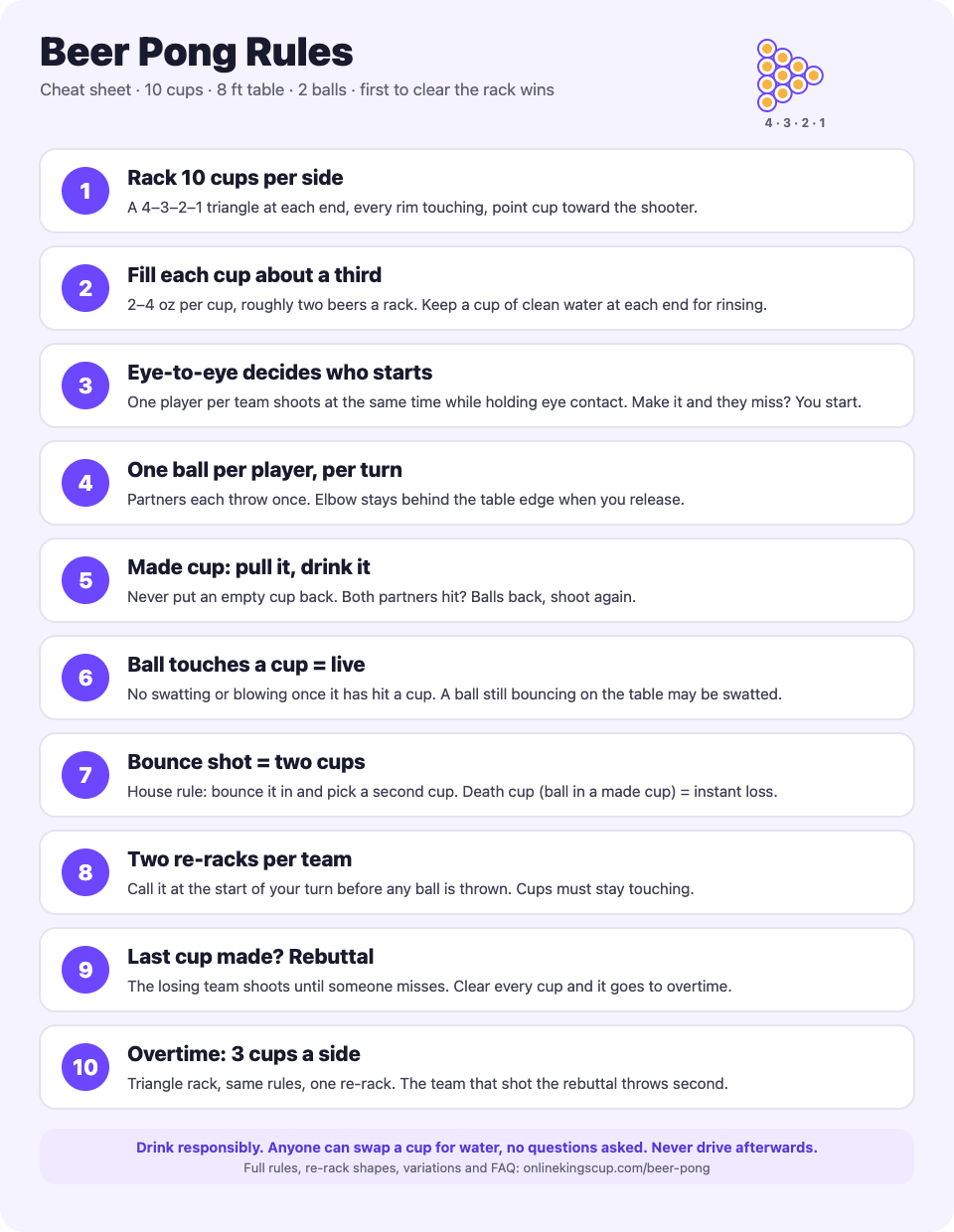
Ten rules, one image. Download it to your phone, print it and tape it to the wall behind the table, or screenshot it for the group chat before the party.

Beer Pong FAQ
How many cups are in beer pong?
Ten per side, racked in a four-three-two-one triangle with the point aimed at the shooter. Short games use six cups in a three-two-one triangle, and casual tables sometimes play fifteen in a five-four-three-two-one rack.
How much beer goes in each cup?
Two to four ounces per cup, which is about a third of a standard 16-ounce cup. Two beers split across a ten-cup rack is the usual pour. Tournament play fills the cups with water and each player drinks from their own separate beer instead.
How big is a beer pong table?
The regulation table used by the World Series of Beer Pong is 8 feet long, 2 feet wide and 27.5 inches high. Any long table works for a house game; keep both racks the same distance from the shooters so neither side has an easier throw.
How far apart are the cups in beer pong?
On a regulation 8-foot table the two point cups sit about 6 feet apart, because each rack takes up just over a foot at its end. A shooter throwing from behind the table edge is roughly 7 feet from the nearest cup and 8 feet from the back row. On a shorter table the distance shrinks with it.
Do bounce shots count for two cups?
In most house games, yes: a ball bounced off the table into a cup removes that cup plus one more of the shooter’s choosing, but defenders are allowed to swat a bouncing ball away. Tournament rules generally do not award a bonus cup. Decide before the first throw.
What happens if both balls land in the same cup?
Nothing, under the official rules — it is simply two cups made. The common house rule treats it as a death cup that ends the game instantly, and a middle-ground version removes three cups. Agree on which one you are playing before you start.
What is a death cup in beer pong?
A death cup is a cup that has already been made but is still sitting on the table, not yet drunk. If a ball lands in it, the team that left it there loses on the spot. It is a house rule rather than an official one, and it exists to make people drink their cups promptly instead of letting them pile up.
What is a re-rack in beer pong?
A re-rack pushes the remaining cups back into a tight formation. Each team usually gets two per game, called at the start of their own turn, and the cups must stay in contact with each other. Common shapes have names: the six-cup triangle, the four-cup diamond, square or zipper, the three-cup triangle or stoplight, and the two-cup gentleman’s rack.
What is redemption in beer pong?
Redemption, also called the rebuttal, is the losing team’s last chance. Once their final cup is sunk, every player on that team shoots until someone misses. If they clear all the winning team’s remaining cups, the game goes to overtime with three cups per side.
Can you blow or finger the ball out of a cup?
Only as a house rule, and only while the ball is still spinning inside the cup and has not settled in the liquid. Some tables let anyone do it, some limit it to female players, and tournament rules ban it outright. Once the ball touches the drink the cup is gone.
What is the elbow rule in beer pong?
Your elbow must stay behind the end of the table when you release the ball. Break it and the shot does not count, even if it goes in. Leaning over the table with your body is allowed as long as the elbow stays behind the line.
Can you play beer pong with 3 players?
Yes. Either play two against one, with the solo player throwing both balls each turn so both sides get two shots, or play one-on-one with six cups and let the winner stay on while the loser hands the table to the third player. Give the solo player a smaller rack if the skill gap is wide.
Can you play beer pong without alcohol?
Yes. Fill the cups with water, soda or juice and keep every other rule the same, or play for points where each cup made is worth one and the first team to ten wins. The throwing and the racks are what make the game, not what is in the cups.
Why is beer pong also called Beirut?
The throw-only version of the game picked up the name Beirut at north-eastern US colleges in the 1980s, most likely as a dark joke about lobbing things at a target during the shelling of the city that was in the news at the time. At Dartmouth, where the original paddle game started, “pong” still means the paddle version, so Beirut is used to tell the two apart.
No Table? Play Kings Cup Instead
Beer pong needs eight feet of table and twenty-two cups. Kings Cup needs a deck — or just this page. Free, no account, no download.
Play Kings Cup Online